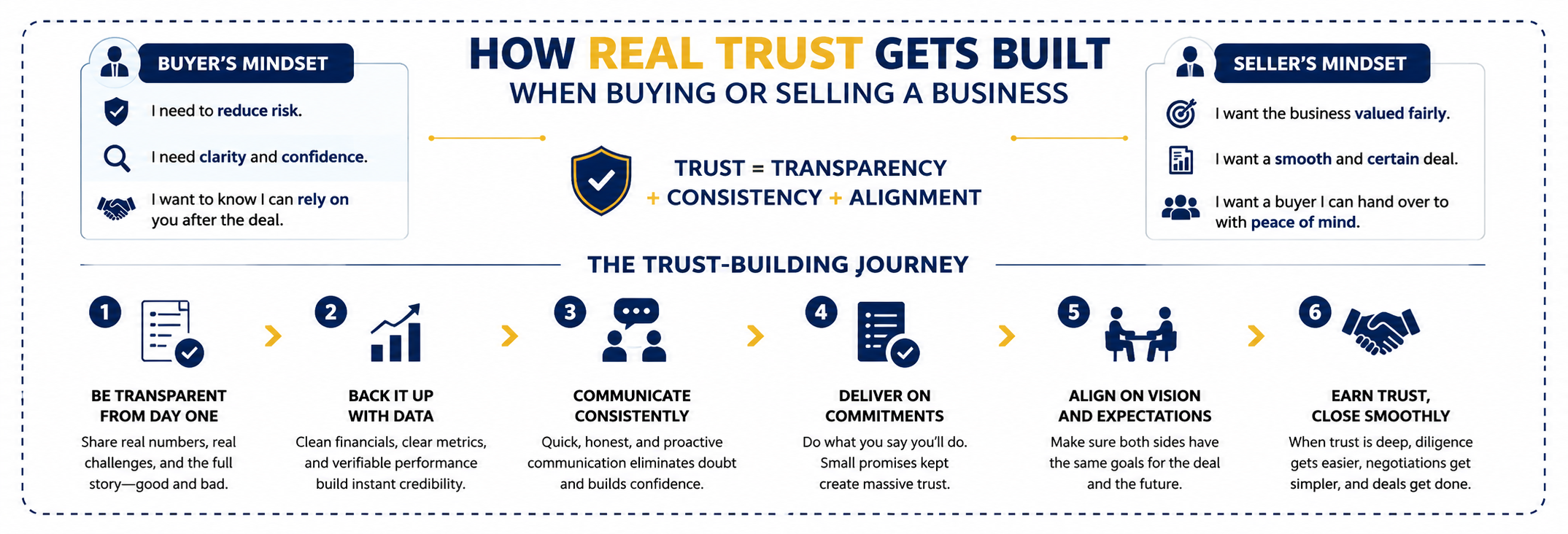
How Real Trust Gets Built When Buying or Selling a Business?
Adarsh Singh
6 August 2026
Most founders and buyers believe trust in a serious deal comes from polished websites, clever positioning, or confident claims. It doesn’t. The kind of trust that lets people share financials, sign NDAs, and move real money is built far more practically—through systems that reduce the need for leaps of faith.
Once upon a time in the high-stakes world of business deals
Picture a founder who has spent years building something valuable. One day the decision arrives: sell, raise, or acquire. Suddenly sensitive numbers must leave the safe circle of the company. Counterparties appear from networks, marketplaces, and introductions. Everyone claims seriousness. Yet the moment financials or customer data enter an email thread or a casual chat, a quiet calculation begins: Can I trust this person? This is the everyday reality for most people buying or selling a business. Claims are cheap. Verification is rare. Random inquiries, unvetted buyers, and unstructured conversations create constant second-guessing. Deals stall not because the economics fail, but because the environment never felt safe enough for real progress.
Every day the friction compounds
Without independent filters, both sides waste time. Sellers field tire-kickers. Buyers dig through listings that may or may not reflect reality. Email threads scatter documents. Motives stay opaque. One poorly handled introduction or a deal that collapses from process failure damages reputation more than a hundred marketing statements can repair. Consistency becomes almost impossible when every interaction starts from zero trust. Research and practitioner experience keep confirming the same pattern. Trust influences outcomes far more than most people admit. Advisors and dealmakers who demonstrate competence, clear motives, fair means, and accountability close more successfully. Relationship capital compounds through repeated, substantive contact—not through branding alone.
One day the realisation hits
The breakthrough is simple yet profound: trust starts when an independent filter exists. Listings that must pass review before going live. Users who are approved rather than open to anyone. Information that undergoes a basic check. When both sides know the other has already been screened, the conversation changes. The defensive posture softens. Serious people can talk like serious people. Structure then creates safety. Sharing numbers and negotiating terms only feels reasonable inside a clear process and a secure place to do it. Random chats and scattered email do not build trust. Structured, auditable interactions do. Removing noise matters more than adding features. Nothing erodes confidence faster than constant contact with people who are not serious. Platforms that filter for genuine buyers, sellers, and advisors let participants move forward instead of endlessly second-guessing motives.
Because of that, consistency and outcomes begin to compound
One clean introduction. One professional process. One deal that does not fall apart from poor handling. These moments build more durable reputation than any claim of “we’re trusted.” Track record always outperforms positioning language. The strongest signal is when people close deals and return—or refer others. This is the practical architecture platforms like MergeDeck are applying in the business buying and selling space: verified listings reviewed before they go live, approved users screened for seriousness, secure messaging and auditable deal rooms for NDAs and diligence, and a deliberate focus on genuine counterparties rather than open noise. The result is not the absence of risk—risk never disappears in deals—but a dramatic reduction in unnecessary uncertainty. People no longer have to take large leaps of faith just to start a conversation.
Because of that, the entire dynamic shifts
Founders spend less energy proving they are real. Buyers spend less energy filtering tire-kickers. Advisors operate inside clearer processes. Deals that once stalled in email chaos move through structured stages. Reputation compounds because outcomes become visible and repeatable. Trust stops being a vague feeling and becomes an engineered property of the system.
Until finally trust becomes the default condition rather than the exception
The deepest insight is this: trust is not primarily built by saying “trust us.” It is built by designing systems where people do not have to take big leaps of faith just to begin. Verification beats claims. Structure creates safety. Filtering noise protects everyone’s time. Consistency compounds. Outcomes remain the ultimate proof. Whether you are preparing to sell the company you built, acquiring your next one, or advising either side, the practical path is the same. Seek environments that make seriousness the baseline rather than the exception. The platforms and processes that do this well are not selling branding. They are engineering the conditions under which real deals can actually happen. Curious what others have experienced—especially founders who have bought, sold, or raised. What has actually built (or broken) trust for you in a deal?
Frequently Asked Questions
Why does verification matter more than marketing claims when buying or selling a business?
Anyone can claim seriousness. Independent review of listings and approval of users creates a shared baseline. When both sides know the other has already passed a filter, conversations start from a different place and progress becomes possible.
How do secure deal rooms improve trust during due diligence?
Random email threads scatter sensitive documents and leave no clear audit trail. Structured, controlled environments for NDAs, document sharing, and negotiation reduce the sense of exposure and keep the process professional and trackable.
What happens when a platform fails to filter out non-serious participants?
Time and emotional energy are wasted. Sellers field endless low-quality inquiries. Buyers dig through unreliable information. Trust erodes quickly because every interaction requires starting from suspicion rather than shared seriousness.
Can consistency and track record outweigh a strong brand?
Yes. One clean process and one deal that closes without unnecessary drama build more lasting reputation than repeated claims. People remember how the process felt and whether outcomes matched promises.
What should founders look for in a platform or process when preparing to buy or sell?
Look for independent verification of listings, screening of users, secure and auditable spaces for sensitive discussions, and evidence that the platform prioritizes serious counterparties over volume. These design choices reduce the leaps of faith required at every stage.