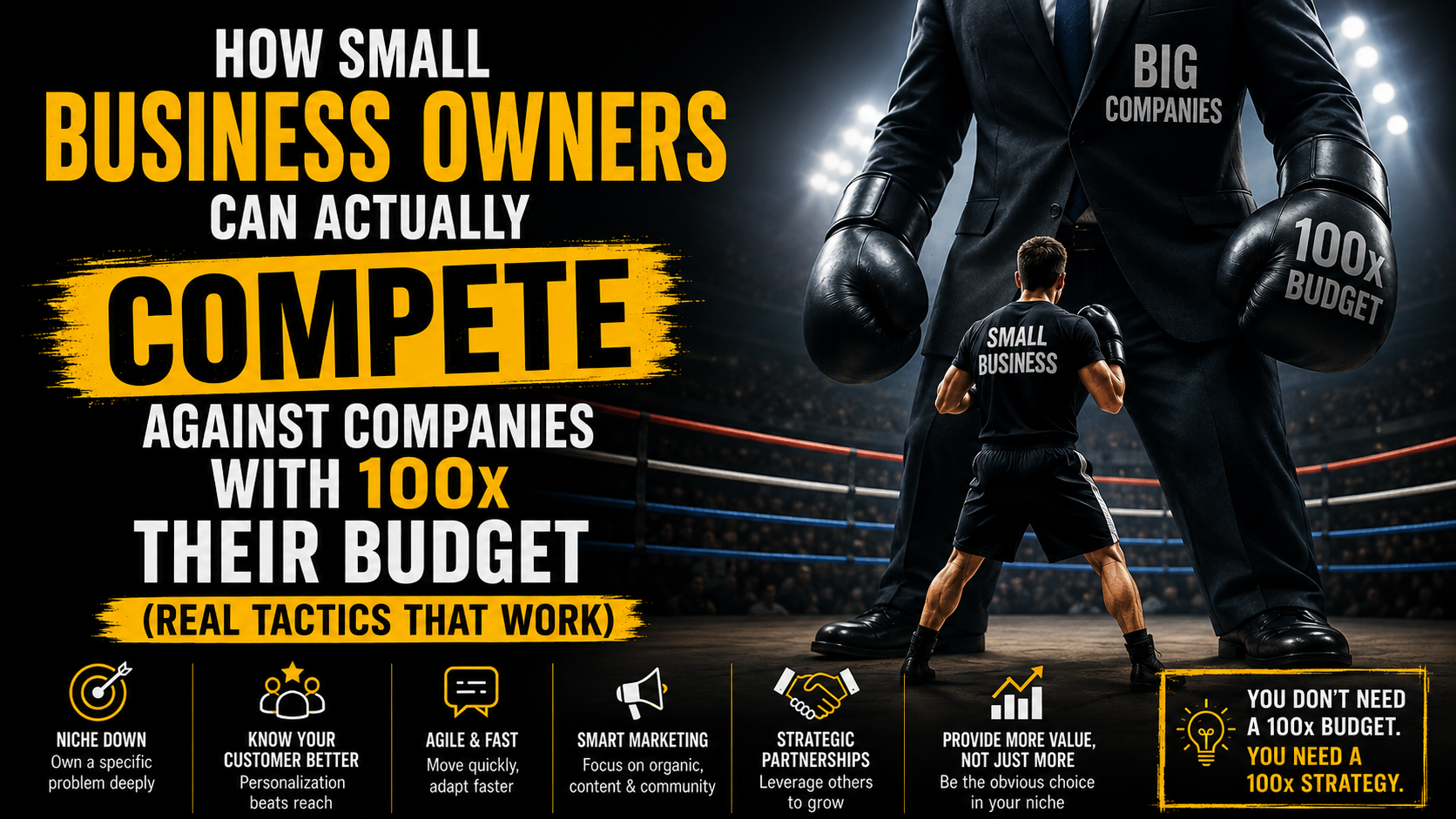
How Small Business Owners Can Actually Compete Against Companies With 100x Their Budget (Real Tactics That Work)
Adarsh Singh
4 August 2026
You started a business because you saw a better way. Maybe it was a bakery that actually remembered regulars’ names, a consulting firm that answered the phone like a human, or a local service that fixed problems without making customers jump through corporate hoops. You believed the little guy still had a shot.
Every Day the Giants Seemed Unbeatable
Every day the market told you otherwise. You watched companies with marketing budgets larger than your annual revenue flood every channel at once. They ran polished ads, published content calendars weeks in advance, and staffed call centers that took three days to send a form letter reply. Meanwhile you tried to keep up. You posted on Instagram, LinkedIn, Facebook, TikTok, and email. You offered a little bit of everything so you would not miss any customer. You treated every new lead like a transaction because there simply were not enough hours. Orders stayed flat. Referral rates stayed mediocre. And the quiet voice in your head started agreeing with the internet. The little guy cannot win anymore.
One Day the Real Advantage Became Clear
One day something shifted. A local bakery owner you knew stopped trying to do social media. She abandoned the pressure to be everywhere and went absurdly deep on three local Facebook groups. No paid ads. No fancy carousels. Just consistent helpful presence where her actual customers already gathered. Within months she was getting more orders from those three groups than she ever had from Instagram. Around the same time a customer told you almost casually, “I emailed three places. You answered in twenty minutes. The big one still has not replied.” That single sentence landed differently. Big companies are slow. They have twelve people in a meeting deciding whether to change a font. You do not. That was the entire advantage and most small businesses never actually use it.
Because of That, Focus, Speed, and Care Started Compounding
Because of that realization you stopped spreading yourself thin. You picked one channel and went deep. For some owners it is local Facebook groups or a single neighborhood community. For others it is a tightly focused email list or one high intent Google Business Profile. The point is concentration of force. Large competitors try to be present everywhere at once and end up mediocre on five fronts. You can become impossible to ignore on one. Consumers especially younger ones already prefer supporting local and smaller businesses when the experience feels personal. Your job is not to out advertise the giants. It is to own the places they ignore. Because of that sharper focus, speed became a weapon. When a customer emails a Fortune 500 company they wait days for a scripted reply routed through layers of approval. You can answer in twenty minutes like a human. Smaller teams average far faster replies than enterprise ones and the businesses that respond within minutes close at dramatically higher rates. Speed does not feel like efficiency to the customer. It feels like care. That single shift of replying while the question is still warm turns skeptics into loyalists faster than any ad campaign. You also stopped trying to serve everyone. We do everything competes with everyone. We are the only ones who do X for You people competes with almost no one. You niche down until it feels uncomfortable. The bakery that went all in on gluten free celebration cakes for a specific local community, the HVAC tech who only services restaurant kitchens, the consultant who only works with independent schools. These businesses stop fighting over the same broad pool and start owning a slice the big players cannot justify serving. The riches really are in the specifics. Then you borrowed trust instead of begging for it. Before you scaled anything you got one credible person or community to vouch for you. One real testimonial from someone your audience already trusts outperforms fifty ads. It can be a well known local business owner, a respected community group leader, or a past customer whose name carries weight in the niche. Large companies buy awareness. You earn belief by association. Finally you treated your first hundred customers like gold. Big companies cannot do personal at scale. You can. Handwritten notes after a purchase. Following up personally a week later to ask how it went. Remembering the details they shared last time. These gestures cost almost nothing yet create the kind of customers who market for you. Customers expect and will pay more for better service from smaller businesses and a good experience with a small business changes buying behavior more powerfully than the same experience with a large brand.
Until Finally You Compete on Your Own Terms
Until finally the scoreboard starts to look different. The bakery no longer worries about Instagram algorithms. The service business closes deals because it answered first. The niche specialist stops competing on price and starts competing on being the only obvious choice. Referrals arrive without being asked. Customers tell their friends they actually care. You are no longer trying to match the giants’ budget. You are using the advantages their size makes impossible for them to copy. Focus instead of scatter. Speed instead of process. Specificity instead of breadth. Borrowed trust instead of paid reach. And human attention instead of automated systems. The little guy can still win. Most just never actually use the weapons they already have. If you have tried one unconventional move that outperformed the obvious marketing play share it. Real tactics from real operators beat recycled advice every time.