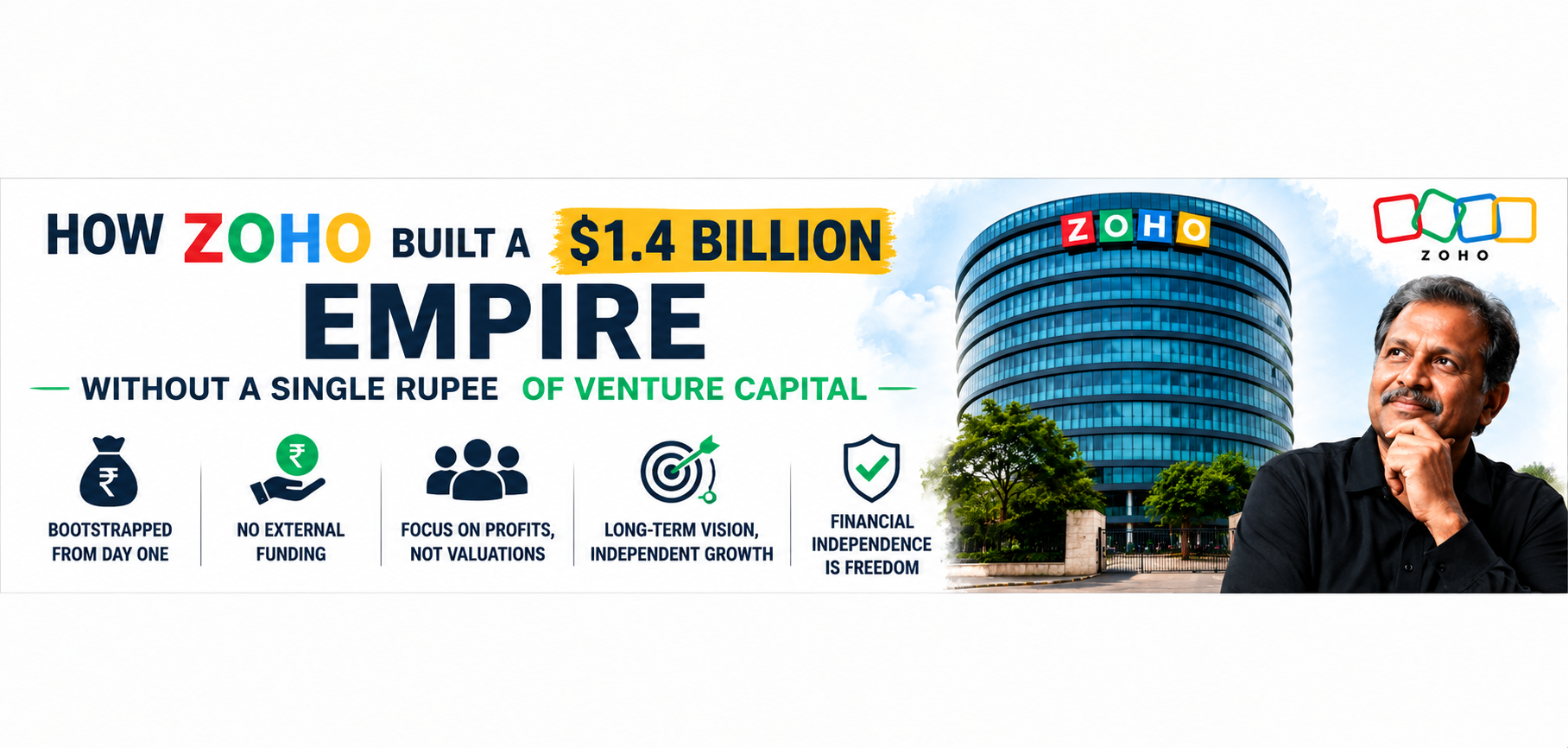
How Zoho Built a $1.4 Billion Empire Without a Single Rupee of Venture Capital
Adarsh Singh
7 August 2026
Every second week a new headline appears about an Indian startup raising a “mega funding round,” burning cash at breakneck speed, and eventually shutting shop or getting acquired for scraps. The cycle feels familiar: big valuations on paper, investor pressure for hypergrowth, layoffs when the music stops, and another down-round story. In that noisy world sits a company that simply refused to play the game.
The Quiet Decision That Defied Silicon Valley Rules
Once upon a time, in the mid-1990s, a small team in a Chennai apartment and a New Jersey operation decided to build software the hard way. Sridhar Vembu and co-founders launched AdventNet in 1996 with personal savings. No term sheets. No venture capital. No private equity. Just product, customers, and the discipline to reinvest every rupee of profit. Every day the broader industry chased the opposite path. Startups raised money, hired aggressively, and optimised for the next funding round or exit. AdventNet (later rebranded Zoho Corporation) did the reverse. In 1999, at the height of the dot-com boom, VCs offered $10 million for a stake that valued the company at roughly $140 million. Vembu turned it down. The strings attached—an eventual exit or IPO—felt like a trap. That single “no” set the trajectory for the next three decades.
From Network Tools to a Full Business Operating System
Because of that refusal, Zoho kept full control. Early profits from network management software funded the next product. ManageEngine, the IT management arm, became a cash engine that still contributes close to 40 percent of group revenue. Those profits then financed the broader Zoho suite—CRM, finance, HR, collaboration, low-code platforms—now more than 55 business applications competing head-on with Salesforce, Microsoft, and Google. The numbers today are hard to ignore. For FY25, Zoho reported consolidated operating revenue of ₹12,313 crore (approximately $1.4 billion), up nearly 18 percent year-on-year. Registrar of Companies filings confirm it as the first bootstrapped Indian company to cross that mark. The company serves more than 100 million users and hundreds of thousands of businesses across 80-plus countries. North America alone accounts for about 41 percent of revenue. It even won the contract to migrate email for over a million Indian central government employees off the older NIC system. No funding drama. No boardroom panic. Just steady compounding.
Building Talent Where Others Would Not Look
Because of that same long-term mindset, Zoho treated talent differently. Instead of competing only for IIT and elite-college graduates in big cities, the company created Zoho Schools of Learning. The programme trains rural and small-town students who may never have attended college, then folds many of them directly into engineering and product roles. A meaningful portion of today’s workforce came through this route. Sridhar Vembu himself moved operations closer to the ground, working out of Tenkasi in Tamil Nadu rather than Silicon Valley or Bangalore. The company deliberately opened offices in smaller towns, reducing costs, improving retention, and spreading high-skill jobs beyond the usual metros. This rural-first approach is not a CSR afterthought—it is part of the operating model that kept the company lean and independent.