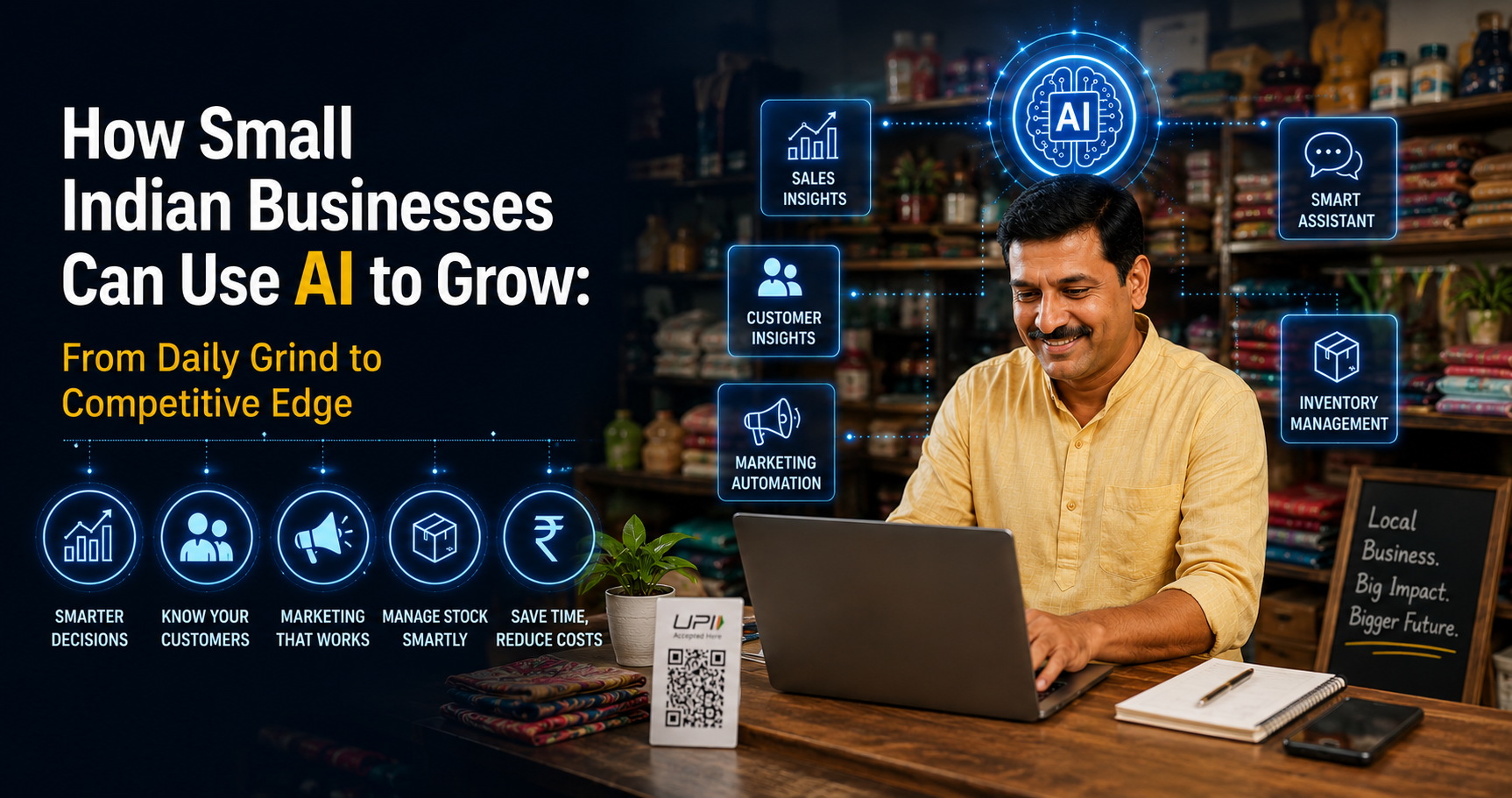
How Small Indian Businesses Can Use AI to Grow: From Daily Grind to Competitive Edge
Adarsh Singh
20 August 2026
Once upon a time, across India’s towns and cities, millions of small business owners ran their enterprises the only way they knew how. A garment trader in Surat, a kirana store owner in Bhopal, a small manufacturer in Coimbatore, or a service provider in Jaipur — each carried the weight of the business on their shoulders. India’s MSMEs contribute nearly 30% of the country’s GDP and employ more than 110–230 million people. They are the backbone of the economy, yet most still operate with limited staff, thin margins, and tools that feel stuck in an earlier decade.
Every Day the Same Exhausting Cycle
Every day looked the same. The owner answered customer messages on WhatsApp late into the night, typed invoices by hand or in basic Excel, posted the occasional festival offer on Instagram after hours, and hoped the stock would last until the next order. Competition from larger players with bigger teams and digital systems felt unfair. Marketing budgets were tiny. Customer queries piled up. Inventory decisions relied on gut feel. Time for actual growth work — finding new customers, improving products, or planning expansion — simply did not exist. A January 2026 NASSCOM survey found that only 14% of Indian SMBs were using AI tools in any systematic way, far behind the 38% in the US and 41% in the UK. Many owners assumed AI was expensive, complicated, or only for big tech companies. The daily friction continued, and growth stayed slow.
One Day, a Simple Discovery Changes Everything
One day the picture shifted. An owner heard about peers who had started with free or low-cost AI tools and were reclaiming hours every day. Or they saw reports showing AI could unlock $490–685 billion in economic value for India’s MSME sector — a potential 45–62% growth boost for a segment that already adds about $1.1 trillion to GDP. The spark was practical, not theoretical. Tools that once required large teams or heavy investment had become accessible on a smartphone. WhatsApp Business integrations, ChatGPT or Claude free tiers, Canva Magic Studio, and Zoho’s AI features meant a small business could begin without hiring data scientists or buying servers. The World Bank noted that AI lets even very small firms perform tasks that previously demanded the management resources of much larger companies — organising finances, handling customer service, creating marketing materials, and reaching new markets. The decision was simple: start with the single most time-consuming task relative to its value.
Because of That, the First Wins Appear
Because of that first step, results appeared quickly. The highest-ROI starting points for most Indian small businesses are clear. Connecting a WhatsApp Business account to an AI chatbot (tools such as WATI, Interakt or DoubleTick, many with free or low-cost tiers) handles common queries — pricing, stock availability, order status, store hours — around the clock. Typical response time drops from 4–6 hours to under two minutes, saving 2–3 hours per day. Pairing this with AI-assisted social media content (Claude or ChatGPT drafting captions, festival offers, product descriptions in Hindi or regional languages) saves another 1–2 hours daily. Together these two changes free 3–5 hours every day that can go straight into revenue-generating work. Both can be live within a week. Know-how in practice is straightforward. Paste a product photo or short description into ChatGPT or Claude and ask for three Instagram captions with relevant hashtags and a Diwali-style urgency. The same tools draft professional replies to Google or Zomato reviews, turn a list of FAQs into polished website or WhatsApp content, and generate GST-compliant invoice language or simple vendor agreement outlines (always review legal text with a professional). Canva’s AI features turn those captions into ready-to-post graphics without a designer. Many owners report that a basic stack of free tiers plus one paid WhatsApp Business Solution Provider plan stays under ₹3,000–5,000 per month while delivering measurable time savings. Customer engagement rises. A regional retailer using AI forecasting cut stockouts by 40% and inventory costs by 25%. Service businesses have seen engagement jump significantly with language-model-powered replies.
Because of That, the Business Begins to Scale
Because of those early wins, confidence grows, and the next layer of AI becomes natural. Inventory and demand planning tools analyse past sales, local festivals and seasonality to suggest reorder points, reducing both dead stock and missed sales. Finance tools inside platforms such as Zoho Books flag cash-flow risks, automate reminders and simplify GST reconciliation. Marketing expands beyond organic posts: AI helps generate more ad creatives, target audiences more precisely, and even access formats that once felt out of reach. Amazon Ads research found that 75% of Indian SMBs using AI-powered advertising said it supported business growth, while 87% reported it opened channels and audiences previously difficult to reach. Operations improve further. Predictive maintenance alerts on machines, visual quality checks via affordable camera-AI setups, and automated lead follow-ups on WhatsApp or email free the owner from firefighting. Some MSMEs adopting agentic workflows have reported 30–40% reductions in administrative overhead and the ability to handle roughly double the order volume without proportional headcount increases. Multilingual support becomes practical — AI drafts and translates replies in Tamil, Telugu, Marathi, Bengali or Gujarati so customers in smaller towns feel understood. The know-how remains sequential and low-risk: master one workflow, measure the hours or rupees saved, then add the next. Avoid trying to automate everything at once. Free or freemium tools, mobile-first interfaces, and AI-as-a-service models remove the need for heavy infrastructure. Vernacular and voice-friendly options matter especially for micro-enterprises with limited English comfort or patchy connectivity.
Until Finally, Growth Becomes the New Normal
Until finally the daily reality changes. The same small business that once struggled to keep up now answers customers faster than many larger competitors, produces professional content consistently, keeps inventory leaner, and makes decisions backed by clearer data. Time previously spent on repetitive tasks returns to the owner — for strategy, family, or expanding into new product lines or cities. Productivity gains of 15–20% and operational cost reductions of 20–30% become realistic when AI is applied thoughtfully. This is not a distant future. Over half of surveyed online sellers on platforms such as Snapdeal already use AI tools in some form, most commonly for product listings and content. More than half of MSMEs now view AI as core to future growth. The gap between those who start and those who wait is widening, yet the entry barrier has never been lower. The practical path for any small Indian business is clear: identify the single task that drains the most time relative to its value, implement one free or low-cost AI solution this week (WhatsApp chatbot or content drafting), measure the hours reclaimed, and expand from there. Government frameworks, cluster-based awareness centres, and an expanding marketplace of affordable tools are making the journey easier. The transformation is already underway for those willing to take the first measured step. AI will not replace the Indian small business owner’s knowledge of local customers, relationships and grit. It simply multiplies that knowledge so a team of five can operate with the reach and responsiveness once reserved for companies ten times larger. The opportunity is real, the tools are accessible, and the first wins can appear within days. Start with one task. Measure the difference. Then keep going