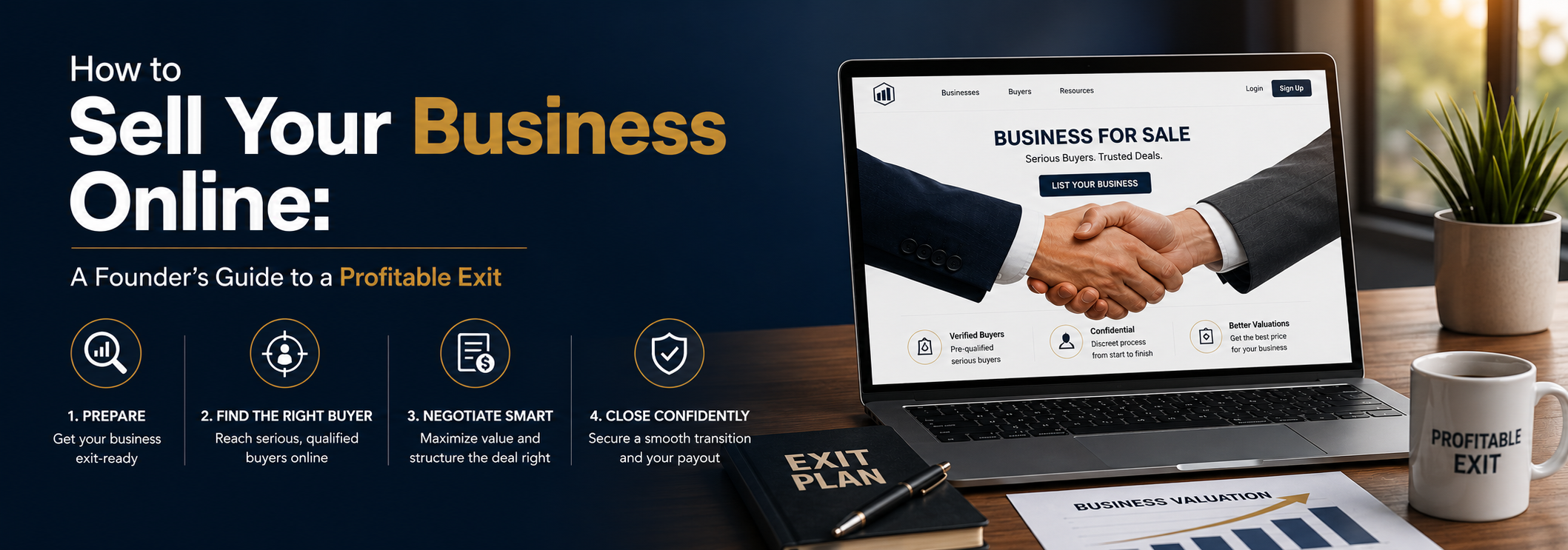
How to Sell Your Business Online: A Founder's Guide to a Profitable Exit
Adarsh Singh
22 July 2026
Most founders spend years building a business and only a few frantic weeks figuring out how to sell it. That mismatch is expensive. India's M&A market crossed roughly INR 6.5 lakh crore (about $78 billion) in deal value in FY 2025-26, and the market is projected to keep growing at an 8-12% CAGR through 2030. Yet the vast majority of that activity is still concentrated around large, well-advised transactions. If you're a founder, agency owner, or small company promoter trying to sell your business online, you're often left to figure out valuation, buyer outreach, and due diligence with a WhatsApp group, a broker's cold call, and a lot of guesswork. This guide walks through the practical process of selling a business online, from valuation to closing, and where a verified marketplace like MergeDeck fits into that process. Whether you're exiting a SaaS product, a private limited company, an NBFC, or a services business, the framework below applies.
Why Selling a Business Online Is Still So Hard for Founders ?
Every day, thousands of Indian founders and small business owners quietly explore an exit. Most hit the same wall. MSMEs are the backbone of the Indian economy, contributing an estimated 31.1% of GDP and spanning over 7.85 crore registered enterprises, but the infrastructure for selling one of these businesses hasn't kept pace with the infrastructure for starting one. The result is a fragmented, low-trust process. Sellers post in Facebook groups or forward decks to a handful of contacts and hope something sticks. Buyers, meanwhile, struggle to tell a genuine opportunity from a shell company or an inflated listing. Recent industry data on failed M&A deals suggests up to 70% collapse due to poor planning, and another 30-50% stall specifically because of weak due diligence. None of that is surprising when the starting point is an unverified WhatsApp forward rather than a structured listing. Three problems show up again and again in this informal process: No verification layer. Anyone can claim a business does a certain revenue. Buyers have no easy way to separate real operators from time-wasters, and sellers can't tell a serious acquirer from someone fishing for free information. No structured comparison. Without a marketplace to browse, buyers can't easily compare a Delhi-based NBFC against a Gujarat trading company or a SaaS product against a content site, which slows decision-making on both sides. No secure way to share sensitive data. Financials, customer lists, and compliance documents end up in email threads and personal WhatsApp chats, with no audit trail and no NDA structure to protect either party. For founders outside the largest metros or outside a founder's existing investor network, these gaps aren't a minor inconvenience. They're often the reason a sale never happens at all.
What Is MergeDeck and How Does It Change the Process
MergeDeck is a global M&A marketplace, with a strong current base of listings across India, built to connect four types of participants in one place: sellers, buyers, M&A advisors, and investors. Instead of scattering conversations across brokers and inboxes, the platform centralizes listings, messaging, and deal documentation. A few structural choices separate this from an open classifieds board: Admin-verified listings. Every seller, buyer, advisor, and investor profile goes through an approval step, which the platform states typically completes within 24 hours, before it becomes visible in the marketplace. Role-based listings across business types. The marketplace spans SaaS, e-commerce, mobile apps, private companies, NBFCs and finance businesses, newsletters, YouTube channels, and general websites or blogs, so a listing is filed by category rather than lumped into one generic feed. In-platform secure messaging. Buyers and sellers exchange information, negotiate terms, and sign NDAs inside a deal room rather than over unsecured email or chat apps. A connected advisor and investor network. Chartered accountants, M&A advisors, and legal counsel are part of the same ecosystem, so a founder who needs help structuring a deal isn't starting that search from zero.
How to Sell Your Business Step by Step on MergeDeck
Because the marketplace centralizes the process, selling a business online through it follows a fairly consistent sequence, even though the underlying business types vary widely.
- Value the business honestly Before listing anything, get a realistic number. Smaller businesses, especially those under roughly $5 million in revenue, are usually valued on Seller's Discretionary Earnings (net profit plus owner's salary, one-time costs, and non-cash charges) rather than EBITDA, which assumes a professional management layer already in place. Multiples vary sharply by category. A compliant but pre-revenue private limited company might trade near its paid-up capital, while an operating NBFC with a clean compliance record and real net worth commands a very different multiple. Pricing a listing too high is one of the fastest ways to sit unsold for months.
- Prepare documentation before you list, not after a buyer asks Buyers on a verified marketplace expect verifiable information: incorporation documents, ROC filing history, GST status where applicable, bank or payment processor statements, and for regulated entities like NBFCs, evidence of RBI compliance. Businesses that can't produce this quickly lose credibility fast, even if the underlying numbers are solid.
- Create your profile and get approved Sign up as a seller (or buyer, advisor, or investor, depending on your role) and go through the platform's verification step. This is what keeps the marketplace from degrading into the same low-trust environment as an open classifieds board.
- List with a clear, specific description The listings on the platform that read as most credible are specific: compliance status, capital structure, promoter history, sector, and location, rather than generic claims like "great opportunity, act fast." A school listing, for instance, is far more compelling when it states exact built-up area and student fee averages than when it simply claims "high growth potential."
- Screen inbound interest through secure messaging Not every inbound message is a serious buyer. Use the in-platform messaging and NDA tools to screen for genuine intent before sharing sensitive financials, and be direct about deal-breakers (minimum price, timeline, whether you'll consider an earn-out) early in the conversation.
- Negotiate and move to due diligence Once a buyer is qualified, negotiation typically covers price, payment structure, and any transition support you're willing to provide post-sale. From there, expect the buyer to request financial statements, filing history, and any regulatory documentation relevant to your sector.
- Close and transfer Finalize terms, execute the transfer of shares or assets, and update statutory records with the Registrar of Companies where applicable. For regulated businesses like NBFCs, factor in additional regulatory approval time before the deal is fully closed.
Valuation, Deal Structures, and Compliance: What Indian Sellers Need to Know
Selling a business in India carries a layer of regulatory nuance that generic "how to sell a business" advice from other markets tends to skip. Compliance status is a valuation driver, not a formality. A "fully compliant" private limited company, meaning current on ROC filings, with no defaults, penalties, or pending litigation, consistently commands buyer interest that a company with gaps in its filing history does not. Several listings on the marketplace explicitly lead with compliance status for exactly this reason. Deal structure varies more than a simple cash sale. Depending on the business type, deals range from a straightforward asset or share purchase to a promoter stake transfer (common for listed entities being acquired as a restructuring vehicle) to structured earn-outs tied to post-sale performance. Each structure carries different tax treatment, so involving a chartered accountant or M&A advisor before signing terms is not optional in any deal above a token size. Regulated sectors add a compliance layer on top of the commercial deal. NBFCs, for example, are frequently sought after specifically because of their RBI registration, but any change in control typically requires regulatory notification or approval, which extends the closing timeline well beyond a standard business sale. Sector context shapes buyer expectations. A SaaS or roommate-finder-style app buyer will scrutinize user growth and monetization potential even pre-revenue. An ecommerce or healthcare buyer will look at supply chain and distribution network strength. A financial services buyer will focus almost entirely on compliance history and asset quality. Positioning your listing for the right buyer type matters as much as the number you put on it.
Getting Started: Your Exit Starts with the Right Marketplace
Selling a business online doesn't have to mean cold outreach and unverifiable claims on both sides. A structured, verified marketplace narrows the gap between founders who've built something real and buyers who are seriously looking, while giving both sides a secure way to exchange sensitive information before a deal is signed. If you're ready to move forward, create a profile on MergeDeck to list your business, browse active buyer mandates, or connect with an M&A advisor who can help structure the deal.
Frequently Asked Questions
How long does it take to sell a business on MergeDeck?
Timelines vary by business type and size, but expect profile approval within roughly 24 hours, followed by a listing period where buyer engagement depends heavily on how complete and specific your listing is. Smaller, well-documented private companies can move faster than regulated entities like NBFCs, which involve additional compliance steps.
What types of businesses can I list or find on MergeDeck?
The marketplace covers SaaS, e-commerce, mobile apps, private limited companies, NBFCs and finance businesses, newsletters, YouTube channels, and general websites or blogs, alongside listed companies being sold as restructuring vehicles.
Do I need a broker or advisor to sell my business online?
Not necessarily for a straightforward sale, but for anything involving regulated entities, complex cap tables, or earn-out structures, working with an M&A advisor or chartered accountant is strongly advisable given the tax and regulatory implications involved.
How is a business valued before listing it for sale?
Smaller businesses are typically valued on Seller's Discretionary Earnings (net profit plus owner's salary and add-backs) rather than EBITDA. The applicable multiple depends heavily on sector, compliance history, revenue quality, and owner dependency.
How do I protect sensitive financial information while talking to potential buyers?
Use NDAs before sharing detailed financials, share information in stages (high-level first, deeper access only after a buyer is qualified), and rely on in-platform messaging rather than open email threads so there's an audit trail of what was shared and when.