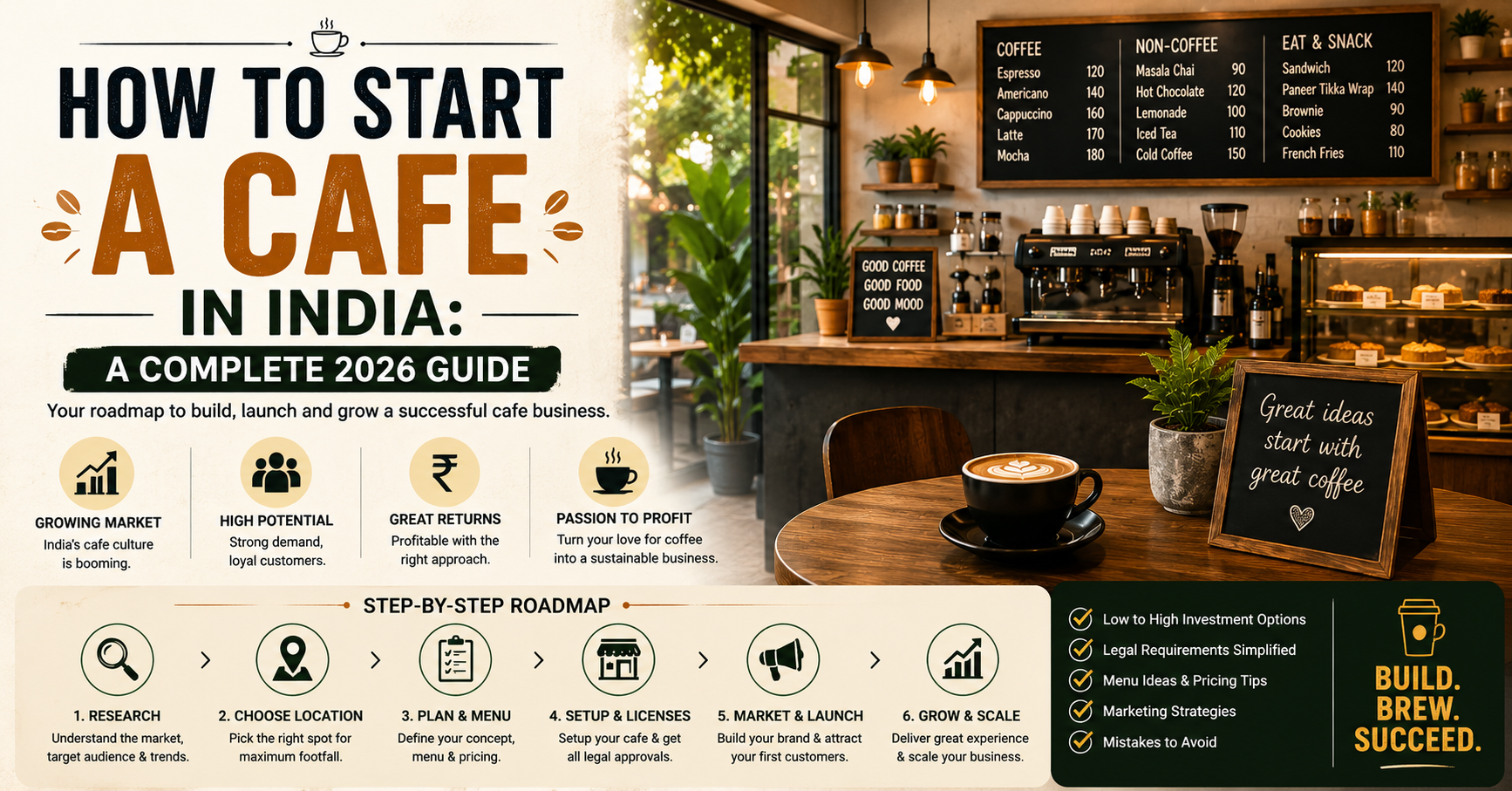
How to Start a Cafe in India: A Complete 2026 Guide
Adarsh Singh
24 July 2026
Urban India seems to be building its social life around cafes right now startup pitches over a flat white, client calls from the corner table, the neighbourhood coffee shop doubling as a second office. If you've caught yourself thinking "I could run one of these," you're not wrong about the opportunity. The harder question is what it takes to go from that thought to a till that rings every morning.
India's cafe boom, by the numbers
This isn't a passing trend. India's coffee shops and cafes market was valued at roughly $425 million in 2025 and is projected to nearly triple by 2034, growing at an annual rate above 11%, according to IMARC Group. The country's broader out-of-home coffee market cafes, kiosks, QSR coffee counters is expected to grow even faster, reaching an estimated $2.6–3.2 billion by 2028 per industry estimates cited by IBEF, as urban professionals shift from occasional treat to daily ritual. The scale players prove the demand is real. Cafe Coffee Day still runs over 1,700 outlets nationwide. Starbucks, through its Tata partnership, has crossed 400 stores across more than 60 Indian cities. And homegrown specialty brands like Third Wave Coffee have expanded to 90-plus outlets across six cities in just a few years, built on nothing more exotic than better beans and a stronger brand story. India itself is now the world's seventh-largest coffee producer, so the raw material advantage is sitting in your own backyard Karnataka alone grows the majority of it. None of that guarantees your cafe succeeds. But it tells you the market isn't shrinking, and it isn't just the big chains eating the growth independent, well-run cafes are opening in Tier-2 cities like Indore, Coimbatore, and Surat, not just Bengaluru and Mumbai.
The real decision: build from zero, or buy your way in
Here's where most first-time owners get stuck. There are really only two paths into cafe ownership, and they carry very different levels of risk. Path one is starting from scratch: finding a space, applying for every license, hiring a team, building a menu, and spending months (sometimes over a year) with zero revenue while you figure out what actually works. Path two is acquiring a cafe that's already licensed, staffed, and has a customer base walking through the door skipping the riskiest early months entirely. Both are legitimate. But you can't choose intelligently between them until you understand what building from scratch actually costs in money, time, and paperwork. So let's walk through it.
Step 1: Get your legal foundation in place
Before you sign a lease, decide your business structure. Most small cafes register as a sole proprietorship or an LLP, since both are simpler to run than a private limited company at this scale, though LLPs make it easier to bring in a partner or investor later. Then come the licenses and this is where a lot of first-time owners lose weeks they didn't budget for: FSSAI license mandatory for any food business, applied for through the FoSCoS portal. Non-negotiable; operating without it can mean serious penalties. GST registration required once annual turnover crosses ₹20 lakh (₹10 lakh in special-category states), and mandatory from day one if you're listing on Swiggy or Zomato. Shop and Establishment Act registration issued by your state's labour department. Trade or health license from your local municipal corporation, tied to your specific premises. Fire NOC typically required once seating crosses a certain threshold; check your city's rule. Music license (PPL/IPRS) needed the moment you play recorded music in-store, and enforcement has tightened recently. Start the FSSAI application the same week you sign your lease. It's usually the slowest piece of the puzzle, and everything else can move in parallel.
Step 2: Pick a format that fits your budget and your market
You don't have to build a 40-seat cafe to get started. The format you choose changes your entire cost structure: A low-cost kiosk near a college, tech park, or transit hub can work on a lean footprint with fast turnover. A cloud or delivery-first cafe skips dine-in real estate costs entirely, leaning on Swiggy, Zomato, and subscriptions instead. A specialty or bakery-cafe built around single-origin coffee and strong visuals works well if you can tell a genuine brand story this is where Third Wave and Blue Tokai built their following. A franchise trades a chunk of your upside for a proven playbook and lower operational risk. Location still does most of the heavy lifting regardless of format. Footfall near offices, colleges, or dense residential pockets beats a "nicer" but quieter street every time.
Step 3: Budget for what it really costs
Industry estimates put a functional small cafe launch anywhere between ₹5 lakh and ₹30 lakh, depending heavily on format and city. A takeaway-first kiosk sits at the low end. A proper 20–30 seat sit-down cafe with espresso equipment, interiors, and a full license stack sits closer to the top. The margins can genuinely work in your favour once you're open: specialty coffee typically carries 65–70% margins, in-house baked goods can run 75–85%, and a well-managed cafe can land 15–25% net margins overall, according to industry benchmarks. But getting there takes time most small cafes need well over a year of steady operations before rent, staff, and raw material costs are fully absorbed by revenue. That gap real cost, real time, no guaranteed payoff is exactly what pushes many aspiring owners to reconsider path two.
Skip the hardest year: buy a cafe that's already running
If the 12-plus months of pre-revenue grind is the part that gives you pause, you don't have to build from zero. An increasing number of profitable, fully licensed cafes across India change hands every year often because the original owner is relocating, retiring, or moving on to a different venture, not because the business itself is struggling. Buying an existing cafe means you inherit a working FSSAI license, an established location, trained staff, and critically real historical sales data instead of a spreadsheet full of assumptions. That last part matters more than it sounds: you can actually verify whether the numbers work before you commit your capital, rather than betting on a forecast. This is precisely the gap MergeDeck was built to close. The platform lists verified, admin-approved cafe and restaurant businesses for sale across India, alongside a network of M&A advisors who can help you evaluate a listing, structure the deal, and handle due diligence properly the same rigor you'd expect from a much larger acquisition, scaled down to a cafe-sized deal. Whether you end up building your own concept or buying your way into someone else's, the underlying opportunity is the same: India's cafe culture isn't slowing down, and there's rarely been a better-documented, better-supported time to own a piece of it.
FAQs
What licenses do I need to start a cafe in India? At minimum, an FSSAI license, GST registration (once you cross the turnover threshold), Shop and Establishment registration, and a trade license from your municipal corporation. Add a fire NOC and a music license depending on your seating and whether you play recorded music. How much does it cost to open a cafe in India? Industry estimates typically range from ₹5 lakh for a small kiosk or takeaway setup to ₹30 lakh or more for a full sit-down cafe with 20-plus seats, depending on your city and format. Is it better to start a cafe from scratch or buy an existing one? Starting from scratch gives you full creative control but usually means over a year without profit while you build a customer base. Buying an existing, licensed cafe with verifiable sales history is typically faster and lower-risk platforms like MergeDeck exist specifically to help you find and vet those opportunities.