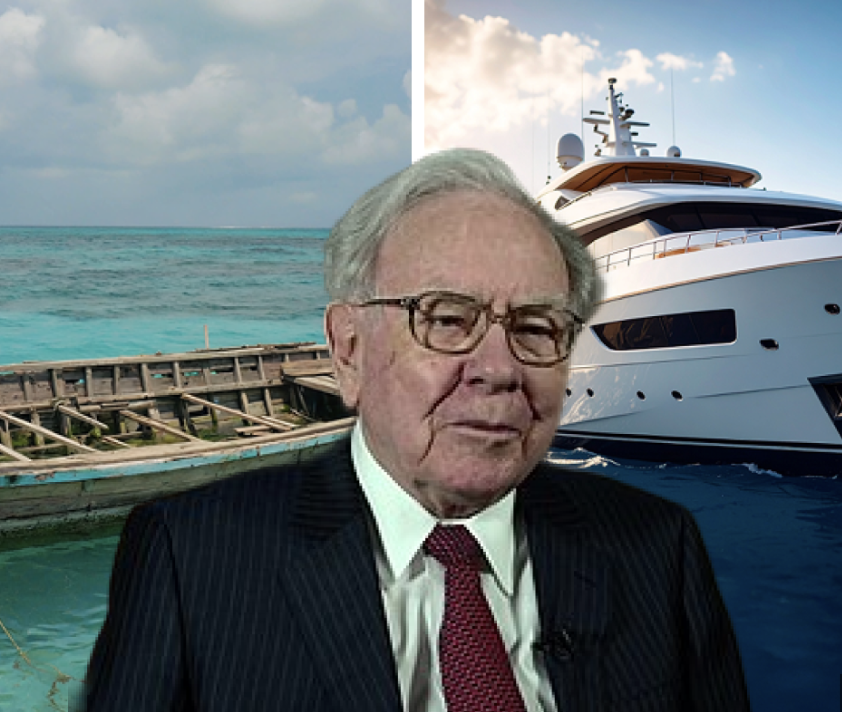
The 400-Foot Yacht Warren Buffett Never Bought
A perfect roadmap for Founders on how to exit
MergeDeck
24 June 2026
In 2009, sitting across from Charlie Rose, Buffett, the third-richest man on the planet, explained why he still lived in the same Omaha house he bought in 1958 for $31,500.
"I could have ten houses instead of one. Would I be happier? Never. I could have ten cars instead of two. I wouldn't be happier. That would drive me crazy."
Then Buffett got specific about the yacht. "I could have a 400-foot yacht. But then I'd have to manage a crew of dozens. Some would steal from me. Some would fight with each other. Who knows what else would happen? If I wanted to be a ship captain, I'd have gone into a different profession."
Buffett wasn't talking about frugality. He was talking about control over time, and he understood that beyond a point, owning more things means being owned by them.
His conclusion is the line every founder should tape to their monitor: "True wealth is not having to buy things you don't want, not having to work with people you don't want, and being able to use your time as you wish. That is the essence of financial freedom."
Most readers will read that quote and nod. But as a founder, you should start implementing, because you started a company to be your own boss. Somewhere along the way, the company became the boss.
For example, you manage a crew, and instead of supporting each other, they fight with each other. You own an asset you cannot use as you wish, the definition of unfreedom by Buffett's own test.
The data reveals just how common this trap is:
- In India, an estimated 75–80% of businesses are family-owned, yet only around 13% survive into the third generation, and roughly 4% reach the fourth. Succession is where founder wealth quietly dies.
- A 2023 PwC family-business survey found that fewer than half of Indian family businesses have a documented succession plan, even though the founders consider the business their single largest asset.
- The classic founder's dilemma research by Noam Wasserman (Harvard) found that founders who hold on to both control and ownership the longest tend to end up poorer, not richer. "Rich" and "king" are usually a trade-off, not a combo.
In clear words, the founders who refuse to ever let go often score worse on Buffett's actual definition of wealth.
Buffett's test translates cleanly into three questions every business owner should be able to answer when applied to your business:
- Do you have to keep buying things you don't want?
- If the business demands constant reinvestment of your capital and your energy just to stand still, you don't own an asset, you own a liability that pays a salary.
- Do you have to keep working with people you don't want?
- The partner you've outgrown. The co-founder relationship ended emotionally three years ago, but never legally. Buffett would call that the crew that steals and fights.
- Can you use your time as you wish?
- This is the only score that matters. If the honest answer is "no, the business won't run without me in the room," then on paper, you may be wealthy, but you are not free.
A business that fails all three tests is not a crown jewel. It's a yacht with a crew you can't fire.
Selling is not surrender, it's the conversion of one kind of wealth into another, this kind of reframe the Indian founder ecosystem badly needs. We have built a culture that treats selling your business as a failure of nerve, a guilt that you "couldn't make it work." That instinct is exactly backwards. A well-timed, well-structured exit is how frozen, time-consuming, and anxiety-generating ownership gets converted into the one form of wealth. Buffett actually praised freedom over your own time.
Buffett, of all people, is not anti-ownership. He is anti-ownership-that-owns-you. The 400-foot yacht failed his test not because it was expensive, but because it would have cost him the thing money is supposed to buy. Your business can pass or fail the exact same test. And if it's failing, the answer isn't to grind harder. It's to find the right associate, structure the deal properly, and walk away owning your time instead of your yacht.
Your business can pass or fail the exact same test. And if it's failing, the answer isn't to grind harder. It's to find the right counterparty, structure the deal properly, and walk away owning your time instead of your yacht.
The reason most founders stay trapped isn't sentiment, it's that they have no idea what a clean exit even looks like. So they wait for an inbound offer that flatters them, accept terms they don't understand, and discover too late that they sold the asset but kept the headaches via a year earn-out.
A successful exit requires:
- Knowing your number before the buyer does, building a defensible valuation on cash flows and comparable, not on a multiple someone quoted at a conference.
- Finding the right acquirer with patience, not the first one, strategic buyers, financial buyers, and successors each value your business differently and treat your people differently after the deal.
- Structuring for freedom, not just price, earn-outs, escrows, lock-ins and management retention clauses decide whether you actually walk away or just change job titles.
This is precisely the problem Mergedeck was built to solve:
Mergedeck is an Indian-first marketplace for business exits, succession, and acquisitions built for founders who've decided they'd rather own their time than their yacht.
If you're a business owner quietly running the Buffett test in your head and not loving the answers, you don't have to wait for a chance phone call from a competitor. You can find serious, vetted buyers, understand what your business is genuinely worth, and run a structured process that ends with you owning your calendar again.
Buffett spent 60 years buying businesses from founders who were ready to convert ownership into freedom. The least we can do is make it easier to be on the other side of that table.
The richest man in Omaha never bought the yacht. The question for you is simpler: is your business the yacht, and is it time to sell it?
If you don’t know the answer very well, Mergedeck can help you find that with currently having 380 active listings representing more than $13 million in assets, with a growing community of 1,300+ verified users across India and international markets. Indian founders find buyers, value their businesses, and structure exits that actually deliver freedom, not just a cheque.
Disclaimer: Quotations are from Warren Buffett's interview with Charlie Rose, 2009.