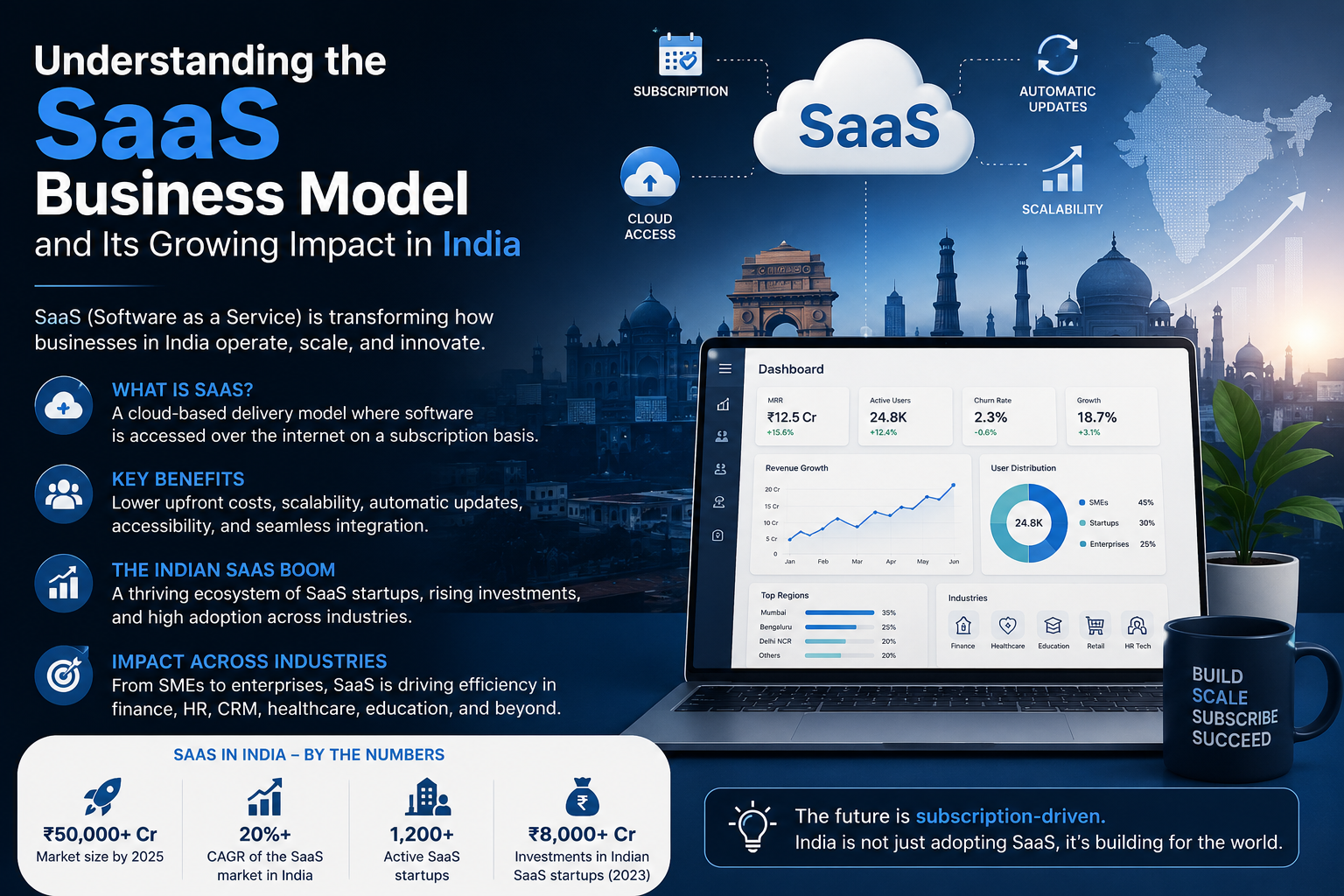
Understanding the SaaS Business Model and Its Growing Impact in India
Adarsh Singh
27 July 2026
Open any Indian office today, a five-person startup in a shared workspace or a two-hundred-person company with its own floor, and you will find the same pattern. Nobody in that building owns the software running on their screens. They log in, they work, and at the end of the month someone quietly pays a bill so the access continues. This is the SaaS business model, and it has quietly become the invisible backbone of how modern companies operate, in India and everywhere else. SaaS stands for Software as a Service. Instead of buying a program outright and installing it on an office computer, a business simply subscribes to it over the internet. The company that built the software keeps it running on its own servers, keeps improving it, and keeps it secure, while every paying customer logs in through a browser or an app. It sounds simple because, from the user's side, it is meant to feel simple. What is happening underneath is a genuine shift in how software gets built, sold and paid for.
Every Day, Businesses Used to Pay a Fortune Just to Get Started
Before this model took over, the routine for any growing business looked very different. If a company wanted accounting software, a customer relationship tool, or an email marketing system, it had to buy a license, often for a large sum, and install it on its own machines. Someone in house had to maintain servers, apply security patches, and troubleshoot problems that had nothing to do with the actual work the company was trying to do. Small and medium businesses, which make up the vast majority of firms in India, simply could not afford this. A proper enterprise software license could cost more than a company's entire yearly budget for technology. So many businesses either did without, or ran on spreadsheets and paper registers long after they had outgrown them. Growth was capped not by ambition, but by the price tag attached to good tools.
One Day, Software Moved Into the Cloud
The turning point came when internet speeds became reliable enough, and cloud computing infrastructure became cheap enough, for companies to host software centrally and simply rent out access to it. Instead of shipping a disc or a download link, a company like Salesforce, Zoho or Freshworks could keep one version of its product running on powerful servers and let thousands of customers use it at once, each seeing only their own data. This single change rewired the economics of software. A customer no longer needed to pay a large amount up front. They could pay a small, predictable fee every month, and stop paying whenever they wanted. For the seller, instead of one large sale followed by silence, there was now a steady, recurring stream of revenue for as long as the customer stayed happy. That single shift, from a one time purchase to an ongoing subscription, is the real engine of the SaaS business model.
How the SaaS Business Model Actually Works
Because of that shift, a fairly consistent structure has emerged across almost every SaaS company, whatever they sell. The product lives in the cloud. The software runs on servers managed by the provider, not on the customer's own hardware. Users simply need a device and an internet connection. Customers share one core product, safely. Most SaaS platforms use what is called a multi tenant architecture, meaning many different customers use the same underlying software while their individual data stays completely separate and private. Pricing is subscription based. Customers typically pay monthly or yearly, often based on the number of users, the features unlocked, or the amount of usage. This is why SaaS pricing pages usually show tiers such as Basic, Professional and Enterprise. Updates happen automatically. The provider fixes bugs and adds features on their own schedule, and every customer gets the improvement instantly, with no manual installation required on the customer's end. Many products start free. A common approach called the freemium model lets people use a limited version of the software at no cost, with the hope that some portion of them will eventually pay to unlock more capability. This combination, cloud hosting, shared infrastructure, subscription billing and continuous updates, is what separates SaaS from the old model of boxed software. It also explains why SaaS companies are valued differently by investors, since predictable recurring revenue is generally seen as healthier and more durable than one time sales.
From Buyer to Builder: India's Own SaaS Story
Because SaaS lowered the cost of running good software so dramatically, something else happened alongside it. Indian entrepreneurs, who had spent years building software for foreign clients as an outsourcing hub, realized they could build and sell their own SaaS products directly to the world. Companies such as Zoho, Freshworks, Chargebee and Postman are now well known names in global SaaS circles, competing directly with American and European rivals rather than simply serving them. According to a market report from Expert Market Research, India's SaaS market was valued at approximately USD 9.14 billion in 2025, and is projected to grow at a compound annual growth rate of around 27 percent through 2035. Other research firms place the growth rate lower, closer to 15 to 17 percent a year, but every serious estimate agrees on the same underlying story: this is one of the fastest growing segments of India's technology economy, whichever exact number ends up being closest to the truth.
Why the SaaS Model Is a Real Opportunity for India
Until finally, this brings us to the practical question most Indian business owners actually care about: what does any of this mean for them. For a small business, SaaS removes the biggest historical barrier to using proper technology, which was cost. A shop owner in a smaller city can now run inventory, billing and customer management on a phone, paying a few hundred rupees a month instead of lakhs up front. That is a genuine leveling of the playing field between a small firm and a much larger competitor. For the wider economy, the rise of homegrown SaaS companies is creating high skill, high paying jobs in product design, engineering and customer success, not only in Bengaluru and Delhi but increasingly in smaller cities too, since SaaS work can be done entirely online. It is also bringing in foreign revenue, since many Indian SaaS companies earn the bulk of their income from customers abroad while employing people locally, which is a favourable position for the country's export earnings. There are real caveats worth naming honestly. Subscription costs can add up over time and sometimes end up more expensive than an old fashioned license for companies that use software for many years without change. Data privacy and reliable internet access remain genuine concerns for smaller towns. And relying on a third party provider means a business's daily operations depend on that provider staying reliable and fairly priced, which is a trade off, not a solved problem. Even with those caveats, the direction is clear. The SaaS business model has turned software from a large capital expense into a manageable monthly cost, and it has turned India from a country that mainly used other people's software into a country that builds a meaningful share of the world's software. For any Indian business owner still weighing whether to switch from old, clunky, self hosted systems to a modern SaaS platform, the honest answer is that the economics, and the direction of the entire industry, are firmly on the side of making the move.