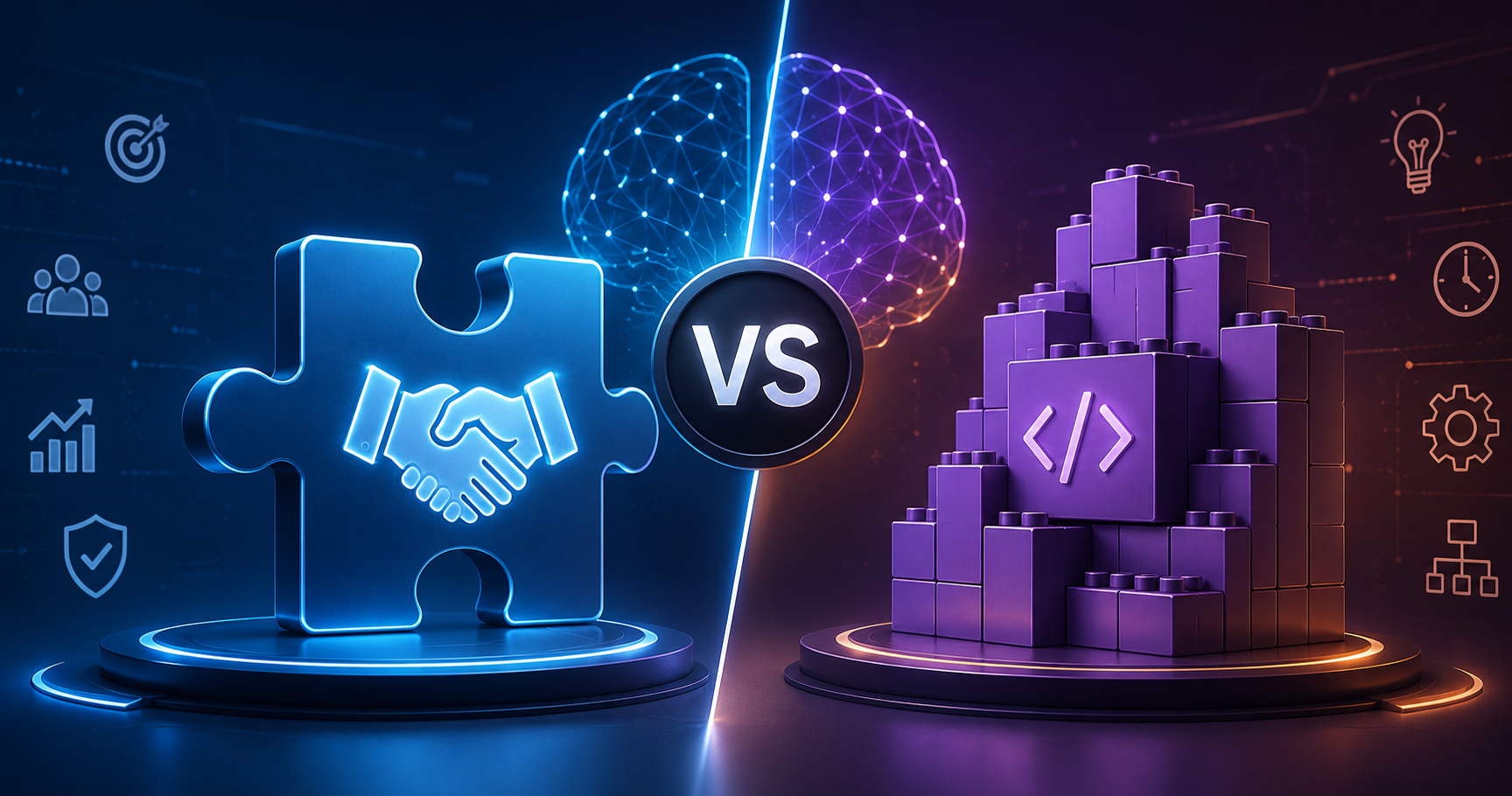
Why Buy vs Build: The Acquisition Framework for the New AI Era
Adarsh Singh
20 July 2026
Every growing company eventually lands in the same room: a leadership team staring at a whiteboard, trying to decide whether to buy an AI tool off the shelf or build something custom. It used to be a fairly simple math problem. License cost against engineering cost, timeline against risk, done. Then generative AI showed up and broke the math. Foundation models, AI coding assistants, and a flood of point solutions have changed what "build" and "buy" even mean. Buying is faster than ever. So is building. And that collision is exactly why so many otherwise sharp operators are making expensive, avoidable mistakes right now.
Every Vendor Says Buy, Every Engineer Says Build
Walk into almost any planning meeting about AI right now and you will feel the tension immediately. The inbox is full of vendor demos promising instant results with zero setup. The engineering team, meanwhile, is quietly convinced they could build something better, faster, and cheaper, especially now that AI assisted coding tools make a working prototype possible in days instead of months. Neither instinct is wrong. That is what makes the decision hard. A generic AI tool can get a team moving this week, but it rarely fits the exact workflow, data structure, or customer experience a business has spent years building. A custom build can fit perfectly, but it comes with a maintenance bill that does not show up until year two, when the original team has moved on and nobody wants to own the code. Most companies do not fail because they picked buy or build. They fail because they picked without a real framework, defaulting instead to whichever option the loudest voice in the room preferred.
What Changed: AI Made Both Options Faster
The old build vs buy playbook, the one written for ERP systems and CRM platforms in the 2000s and 2010s, assumed building was slow, expensive, and risky, while buying was fast, predictable, and safe. That assumption no longer holds. On the buy side, AI native software has compressed sales cycles and onboarding from months to days. On the build side, AI assisted development has cut the cost of a working internal tool dramatically, and no code and low code platforms let non technical teams stand up automations that once required a full engineering sprint. The result is a strange new reality: the traditional cost comparison between buying and building has mostly collapsed, because both paths are now cheap and quick at the prototype stage. The real differences show up later, in ownership, differentiation, and what happens after the initial excitement wears off. That is the part most teams skip past.
The Hidden Cost of Getting This Decision Wrong
When companies apply the old logic to this new landscape, two failure patterns show up again and again. The first is buying commodity software for something that should have been a competitive advantage. A company builds its entire customer experience around a third party AI tool, only to discover a year later that every competitor has access to the exact same tool, so the advantage they thought they were buying never existed. The second is the opposite mistake: building custom AI infrastructure for a problem that was never actually core to the business. Engineering time gets burned reinventing a scheduling tool, a chatbot, or a reporting dashboard that a dozen vendors already sell well, while the actual differentiator the company should have been building sits untouched. Both patterns come from the same root cause. The decision got made on speed and sticker price instead of on what the capability is actually worth to protect or own.
A Better Framework: Four Questions to Ask Before You Decide
A more reliable build vs buy framework for the AI era starts with four questions, asked in this order, before a single vendor call or engineering ticket gets scheduled. Is this capability core to how you win? If it is genuinely part of what makes a customer choose this business over a competitor, it deserves serious consideration for building, even if a good enough tool exists on the market. If it is a supporting function that every company in the industry needs, buying is almost always smarter. Do you have proprietary data that a generic tool cannot use? AI systems get better with the right data behind them. A company sitting on years of unique operational, customer, or product data often gets far more value from a custom model or workflow than from a general purpose tool that cannot see that data at all. What is the real total cost, not just the sticker price? A license fee is easy to compare against a developer's salary. It is much harder to compare against the ongoing cost of security reviews, integration maintenance, and the two or three engineers who will quietly own that system for the next five years. Price the whole lifecycle, not the first invoice. How fast do you actually need this to work? If the business needs a solution live this quarter to capture a window that will not stay open, buying (or partnering with a team that can build quickly on your behalf) usually wins. If the need is strategic and long term, a well scoped build can be worth the extra runway. None of these questions has a universally right answer. What they do is force the decision to be made on the actual tradeoffs instead of on whoever presented most recently.
Choosing the Path That Actually Works
In practice, the best answer for most companies is not a clean buy or a clean build. It is a blend: buy the commodity layer, build the layer that is genuinely differentiated, and lean on outside expertise for the parts that need speed and specialized skill neither internal team currently has. That third option, bringing in an experienced AI automation or software partner to build the differentiated piece without carrying a full internal team, has become one of the more underused paths in this framework. It offers something close to the best of both worlds: the speed of buying, paired with the ownership and fit of building, without the long term staffing commitment that a fully in house build requires. The teams getting this right in 2026 are not the ones with the strongest opinion about buying or building. They are the ones asking better questions before they choose, and revisiting the decision as the technology, and their own data, keeps evolving.