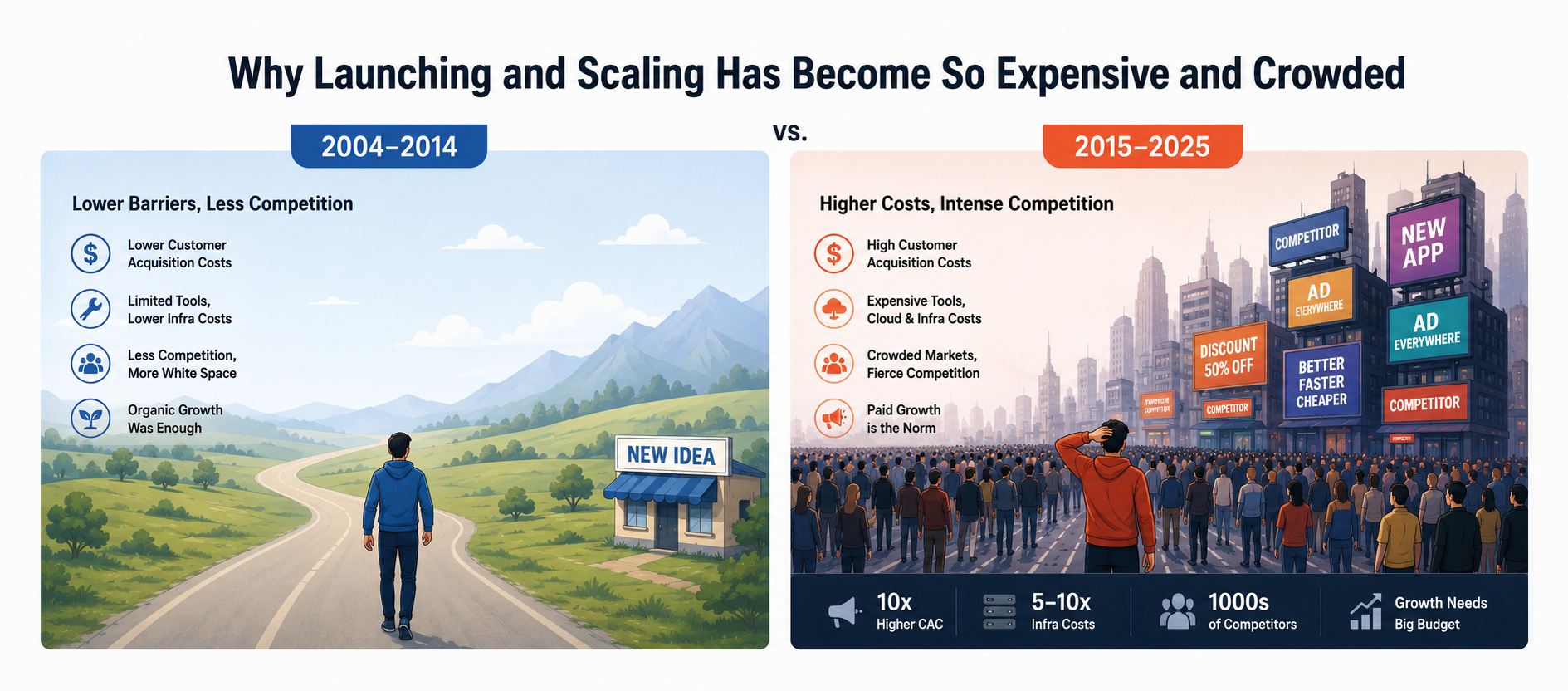
Why Launching and Scaling A Busniess Has Become So Expensive and Crowded (2004–2014 vs. 2015–2025)
Adarsh Singh
24 August 2026
The paradox of modern entrepreneurship is simple: it has never been cheaper to build a product, yet it has never been more expensive to build a sustainable business. Two decades ago, starting an enterprise required tangible upfront capital, technical specialisation, and manual operations. Today, anyone can launch a global storefront, deploy software, or establish an agency in an afternoon. However, this democratisation created an unintended consequence: extreme market saturation, soaring customer acquisition costs, and an operational tax that eats away at margins. To understand why modern founders face such severe headwinds, we must examine how the economic, technological, and marketing realities of doing business evolved across two defining decades: 2004–2014 and 2015–2025.
Customer Acquisition and the End of Cheap Distribution
Between 2004 and 2014, digital distribution experienced a golden era of arbitrage. Platforms like Google AdWords, early Facebook Ads, and emerging social networks offered hyper-targeted traffic at pennies per click. Competition inside ad auctions was low, user attention was unfragmented, and chronological social feeds delivered massive organic reach without requiring paid amplification. Early direct-to-consumer (D2C) brands and software startups scaled to tens of millions in revenue almost entirely on the back of low Customer Acquisition Cost (CAC).
Between 2015 and 2025, customer acquisition transformed from a growth lever into the single largest expense on a company’s balance sheet—often termed "the new digital rent." As millions of new businesses flooded ad auctions, bidding wars drove cost-per-thousand-impressions (CPM) and cost-per-click (CPC) rates to historic highs. This ad inflation was compounded by structural data shifts. Privacy updates—most notably Apple’s App Tracking Transparency (iOS 14.5) framework and global cookie restrictions—severely degraded tracking precision and attribution modeling. Businesses had to spend significantly more capital to achieve a fraction of the historical return on ad spend (ROAS). Meanwhile, organic distribution shifted entirely to pay-to-play models or demanded resource-intensive, high-velocity short-form video production simply to remain visible.
Infrastructure, Software Stacks, and Operational Sprawl
The technical foundation of business shifted dramatically between these two eras, trading high upfront capital expenditure (CapEx) for endless recurring operational expenditure (OpEx). From 2004 to 2014, launching required physical servers, on-premise infrastructure, or early-stage cloud hosting through services like Rackspace and AWS. While initial setup was expensive and required dedicated systems engineers, software costs were largely predictable. Companies purchased perpetual, one-off software licenses for their operating systems, office tools, and design suites. From 2015 to 2025, the software-as-a-service (SaaS) model became the universal default. While SaaS eliminated upfront technical barriers, it introduced severe subscription bloat. The modern enterprise now relies on a fragmented web of monthly subscriptions: customer relationship management (CRM), project management, generative AI tooling, cloud hosting, email delivery engines, data security, analytics, and collaboration suites. What initially appeared to be a flexible monthly cost often compounds into hundreds of thousands of dollars in annual software overhead for mid-sized operations.
Market Saturation and the Collapse of Traditional Moats
In the 2004–2014 era, having a functioning digital product was often a moat in itself. If your software worked or your e-commerce store delivered reliably, you could capture substantial market share. In the 2015–2025 era, code and physical manufacturing were thoroughly commoditised. White-label manufacturing, drop-shipping networks, no-code application builders, and generative AI tools enabled competitors to replicate any business model within weeks. Because product differentiation eroded so quickly, businesses were forced to spend heavily on brand equity, proprietary storytelling, and community building just to stand out in an overcrowded market.
The Rising Burden of Legal, Privacy, and Tax Compliance
The regulatory landscape governing digital commerce expanded significantly over the past decade, creating hidden administrative costs that disproportionately affect growing businesses. During the 2004–2014 window, the digital economy operated in an environment of relative regulatory leniency. Cross-border commerce was unencumbered by complex digital trade laws, tracking customer data required minimal legal documentation, and state-level e-commerce tax obligations were rare. From 2015 to 2025, compliance transformed into a major financial requirement. Comprehensive data privacy frameworks—such as the European Union’s General Data Protection Regulation (GDPR) and the California Consumer Privacy Act (CCPA)—mandated legal audits, specialized compliance software, and strict data governance policies. In e-commerce, the landmark South Dakota v. Wayfair ruling in 2018 established economic nexus laws across the United States, forcing online retailers to calculate, collect, and remit sales taxes across thousands of distinct local jurisdictions. Managing modern distributed, remote teams introduced further legal and payroll complexities across multiple tax territories.
Strategic Playbook: Navigating the Modern Landscape
Thriving in an era of high operating costs and market saturation requires a fundamental shift in business mechanics: Prioritize First-Party Data: Insulate your business from rising ad platform costs by building robust, owned channels via email lists, SMS communities, and direct customer relationships. Optimize for Retention and LTV: When acquisition costs are high, sustainable profit comes from maximizing Customer Lifetime Value. Reducing churn and increasing expansion revenue must take priority over top-of-funnel ad spend. Audit and Consolidate SaaS Overhead: Conduct quarterly software audits to eliminate redundant licenses, negotiate tiered pricing, and move toward unified software platforms. Compete on Hyper-Specialization: In crowded categories, generic offerings fail. Narrow your positioning to solve complex, high-value problems for a clearly defined niche rather than competing for broad, expensive market segments